Posts Tagged ‘everest’

Suffering and Hope

Sunday, May 30th, 2010

For those who may not have been reading my blog too much, I often talk about how much suffering is involved in mountain climbing. What we have to put our minds and bodies through in high altitude mountaineering is not easy; you can’t quite train away the suffering that will have to be endured while acclimatizing on the mountain. It is the main reason I did this climb for charity, it was my way of putting myself into the suffering of those most needy in the world. On that note, there is a quote I heard just today that might put that suffering into a bit of perspective, for why people do it:

“We also rejoice in our sufferings, because we know that suffering produces perseverance; perseverance, character; and character, hope. And hope does not disappoint us.”

Maybe if you’re ever going through some tough times yourself (climbing your own internal Everest) keep the above in mind.

Below, a couple more pictures from the summit, holding flags of the Knights of Columbus. My fellow Knights supported me on this climb both in moral support and donations, so much thanks to them all!

KofC Summit

KofC Summit

Snow Blindness and Sun Burn

Tuesday, May 25th, 2010

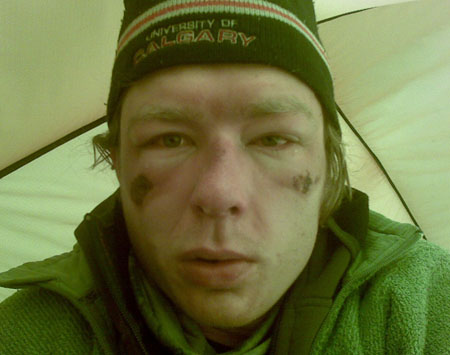
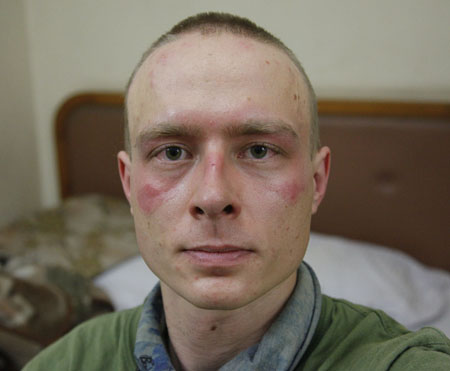
I do not feel like writing too much right now, so I will post another couple of pictures that might tell their own story. While going from Camp 3 to Camp 4 I got sunburned on my cheeks under the sides of my eyes. That is what caused the scabs on my face. Also, while coming down from the summit I got mild snow blindness, which lead to my eyes and upper face being swollen. All together it looked like I got into a fight with the ugly stick and lost badly.

Snow Blindness and Sunburn

Making little mistakes on Everest like I did does have consequences. It’s an unforgiving mountain. Now things are better, I am in Kathmandu, once again back in civilization, enjoying it tremendously. My face seems to be healing well; while I still had scabs on my face it was a definite conversation starter. I got myself a haircut, now all I need is a real job.

Face Healing Well

Take care everyone and see you soon!

Namche Bazaar, 3440m

Saturday, April 3rd, 2010

Today we are taking a rest day at Namche Bazaar, our second stop on the way from Lukla to Everest Base Camp. If you look at our latest dispatch (which I see hasn’t been posted yet) you’ll know that everyone is doing good, and our bags not being here is the only issue that’s not perfect. So I wanted to elaborate on that a little bit because that’s pretty vague.

Myself, I am not feeling 100%. I started getting a little bit sick as we were leaving for our hike. I usually only get sick when I don’t sleep, and that was the case in Kathmandu, due to the jet lag. Also, the hotel room I was in was freshly painted and I seemed to get a little bit of an allergic reaction to that (or who knows what else that may have been in my room?) Anyways, it made me wonder what kind of paint they use in Nepal, somehow I don’t think it’s the latest and greatest in non-toxic paint, and I wonder how much lead is in it? Not something I would normally ask but under the circumstances… Anyways, I had a sore throat on the first day of our hike and felt pretty weak, right now I’m a little stuffed up, but luckily I have been sleeping a lot lately and seem to be getting over it.

I also have some stomach issues, I frequent the bathroom often among other things, but it’s something I experienced already on Cho Oyu, so I’m not too worried about it. I needed stomach antibiotics last time to sort that out, this time I’m hoping the pro biotic tablets I have can help.

There’s others on our team that are not at their best. One member has Giardia (sp?), another got a sore throat at the same time as me, but rather than get better his sore throat has been spreading lower, and now it’s sitting in his lungs. Others are getting typical headaches, things like that.

So things are not all perfect, but honestly this is about standard for these kinds of expeditions. But because it’s normal, don’t expect to hear these kinds of details in the dispatches that we send out.

That’s it for now, we’ll be another week or so in getting to base camp, I’ll try and write more if there’s anything worth mentioning, and if I have internet access. Hope everyone has a good Easter!

Everest Itinerary

Monday, March 29th, 2010

“Two and a half months? Why does it take so long to climb Everest? What will you be doing all that time?” To answer some of those questions, and to give you an idea of what we might be doing any given week you consider checking this blog out, have a look below at our proposed itinerary. Some comments on it at the end.

Arriving in Kathmandu:

March 30) Arrive in Kathmandu (1300 meters/4,250 feet). Hotel.

April 1) In Kathmandu; visit temples, city tour, shopping and restaurants. Hotel.

Trekking to Basecamp:

April 2) Fly to Lukla (2860 metres/9,400 feet). Walk to Phakding (2650 metres/8,700 feet). Teahouse or camping.

April 3) Walk to Namche Bazaar (3450 metres/11,300 feet). Teahouse or camping.

April 4) Rest and acclimatization in Namche. Happy Easter! Check email, send messages at cyber-café, and eat at one of the many great restaurants in town. Teahouse or camping.

April 5) Walk to Pangboche (3750 metres/12,300 feet). Participate in a Buddhist Puja blessing ceremony with the local Lama at the monastery if you wish. Teahouse or camping.

April 6) Walk to Pheriche (4250 metres/13,900 feet). Visit the Himalayan Rescue Association health clinic. Teahouse or camping.

April 7) Walk to Dugla (4600 metres/15,100 feet). Teahouse or camping.

April 8) Walk to Lobuche (4900 metres/16,100 feet).

April 9) Walk to Gorak Shep (5150 metres/16,900 feet). Teahouse or camping.

April 10) Walk to basecamp (5000 metres/17,400 feet).

April 11) Rest, organization, and training day in basecamp.

April 12) Rest, organization, and training day in basecamp.

Climbing Everest:

April 13) Climb partway to camp 1 at 5800 metres/19,000 feet. Return to basecamp.

April 14) Rest in basecamp.

April 15) Climb to camp 1 at 5800 metres/19,000 feet. Return to basecamp.

April 16) Rest in basecamp.

April 17) Climb to camp 1, sleep there.

April 18) Walk to camp 2 at 6200 metres/20,300 feet, return to camp 1, sleep there.

April 19) Return to basecamp.

April 20) Rest in basecamp.

April 21) Rest in basecamp.

April 22) Rest in basecamp.

April 23) Walk to camp 1. Sleep there.

April 24) Walk to camp 2. Sleep there.

April 25) Rest in camp 2.

April 26) Explore route to camp 3 (7300 metres/24,000 feet), return to camp 2, sleep there.

April 27) Return to basecamp.

April 28) Rest in basecamp.

April 29) Rest in basecamp.

April 30) Rest in basecamp.

May 1) Walk to camp 1, sleep there.

May 2) Walk to camp 2. Sleep there.

May 3) Rest in camp 2.

May 4) Walk to camp 3. Sleep there.

May 5) Descend to camp 1 or camp 2. Sleep there.

Rest in Basecamp or Descend to a Lower Village:

May 6) Return to basecamp.

May 7) Rest in basecamp or descend to a lower village such as Pangboche.

May 8) Rest in basecamp or a lower village.

May 9) Return to basecamp from lower village. Rest in basecamp. Happy Mother’s Day!

Summit Attempt:

May 10) Walk to camp 1, sleep there.

May 11) Walk to camp 2, sleep there.

May 12) Walk to camp 3, sleep there.

May 13) Walk to camp 4 at 8000 metres/26,200 feet, sleep there.

May 14) Attempt summit.

May 15) Attempt summit.

May 16) Return to camp 2, sleep there.

May 17) Return to basecamp.

May 18) Rest in basecamp.

May 19) Rest in basecamp.

May 20) Rest in basecamp.

May 21) Rest in basecamp.

May 22) Walk to camp 2, sleep there.

May 23) Walk to camp 3, sleep there.

May 24) Walk to camp 4, sleep there.

May 25) Attempt summit.

May 26) Attempt summit.

Going Home:

May 27) Return to camp 2.

May 28) Pack up camp 2.

May 29) Return to basecamp.

May 30) Pack up basecamp.

May 31) Pack up basecamp.

June 1) Trek down to Pheriche. Camp.

June 2) Trek down to Pangboche. Teahouse or camping.

June 3) Trek to Namche, Teahouse or camping.

June 4) Trek to Lukla. Teahouse or camping.

June 5) Flight to Kathmandu. Hotel.

June 6) Extra day in Kathmandu, in case of delay, and for sightseeing, gift shopping. Hotel.

June 7) Fly Home. Thanks for joining our expedition!

Of course this is just a proposed itinerary. The only thing 100% sure about this itinerary is that we will not follow it. Too many things vary from year to year to predict the detailed movements. But it’s an idea.

Another issue with this itinerary is that it proposes we cross the Khumbu ice fall at least 5 times up and down (it is between Base Camp and Camp 1). I have heard that some expeditions have changed their acclimatisation strategies to not cross the ice fall that often, as it’s the most dangerous part of the route. We’ll see what our plan is.

Here I go again on my own

Friday, March 26th, 2010

Going to climb Everest is one of those things that not many people are going to attempt. That means those of us that do usually have to go on our own and join up with a group once we get there, a group of people we know nothing about. That’s one of the hardest parts, leaving all behind and heading out on your own. It gets better once we all meet up in Kathmandu, and start talking to people that have the same goal as us. But until then I’m on my own, and for me it’s a bit of a difficult part! I usually end up getting this White Snake song stuck in my head, I find it’s surprisingly fitting for this occasion. I’ll share some lyrics below, though it’s better if you hear the song:

I don’t know where I’m going
But, I sure know where I’ve been
Hanging on the promises
In songs of yesterday
An’ I’ve made up my mind,
I ain’t wasting no more time

Here I go again, here I go again

Tho’ I keep searching for an answer,
I never seem to find what I’m looking for
Oh Lord, I pray
You give me strength to carry on,
‘Cos I know what it means
To walk along the lonely street of dreams

An’ here I go again on my own
Goin’ down the only road I’ve ever known,
Like a drifter I was born to walk alone
An’ I’ve made up my mind
I ain’t wasting no more time

I’m just another heart in need of rescue,
Waiting on love’s sweet charity
An’ I’m gonna hold on
For the rest of my days,
‘Cos I know what it means
To walk along the lonely street of dreams

Here I go again on my own
Goin’ down the only road I’ve ever known,
Like a drifter I was born to walk alone
An’ I’ve made up my mind
I ain’t wasting no more time

Dehydrated foods taste bad

Monday, March 22nd, 2010

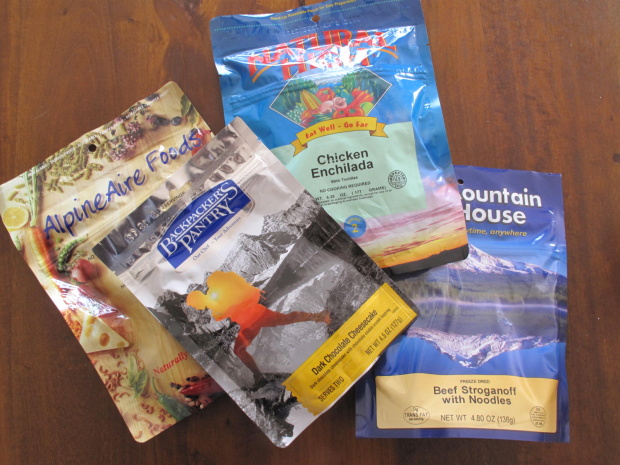
In preparing for my Everest climb, one of the few things I still need to arrange is to have some food to take with me. While most of the food along the expedition is included, once we get to the high camps we have to rely on food we brought and carried up ourselves. Now, the problem with normal food is that a few days worth of it in your backpack can easily be a lot of weight. So one approach is to buy food that is dehydrated, which weighs very little, and you just add boiling water to a package and the contents are ready. Nice solution! The problem with that is it all tastes like crap!

But then again, everything tastes like crap when you’re at altitude. And I have only ever tried dehydrated meals at altitude. In fact, I thought they taste so bad that on my last trip in the Himalayas I could not even make myself open a package and try it. Mentally I was just so disgusted with the prepared dehydrated meal that would be the result that I was getting sick just thinking of it. So I just left them and snacked on other things instead.

In hoping to eliminate this mental block I thought I would prepare some dehydrated meals here at home, where they would come out better, and give them a try. The guy in the mountain store said this should be done, you should try eating them at home to see what you like and what you don’t. And it makes sense, because here you can boil water at 100 degrees (or close to is), whereas in the high camps on Everest you’re lucky if your water boils to 70 degrees. So the meals can be prepared better here.

Anyways, I just tried that with this one meal, and I had to throw half of it out. It was horrible. And while it sucks, I know I’m not alone. I’ve met at least one other accomplished climber who never touches dehy meals. It takes a bit more creativity and planning and thought to put stuff together, but it’s possible. I’m still working out what the best things are, it’s one of the things that I am finding is hardest to learn from one expedition to the next. I may not get it right for this trip but I’ll be closer than last trip. Wish me luck!

Dehydrated Meals

I’m on Twitter

Friday, March 19th, 2010

TwitterI just recently signed up for Twitter, if you want to follow me on it you can find me under wik2010, or you can see my updates at http://twitter.com/wik2010. I think it just might be my best way to keep people updated with what’s going on on Everest. As long as I am able to have some kind of internet or SMS connection while on Everest (and apparently there is cell service at least in base camp), I will try and update what I’m up to with Twitter. So check there first if you want to know what I’m up to!

That’s all you really need to know. But I’m also going to say a few words about Twitter. As long as I have known about it I thought it was one of the stupidest things on the internet. I had no idea why it was becoming popular! And I don’t think I am quite convinced yet, but I can see some potential in it. I think for everyday people it’s not that much use, if what people are sharing is what they’re up to. But for people like celebrities or artists or athletes or anybody that has fans, I can see how hearing from your star and knowing what they’re up to can make people think they’re that much closer. And without having to stalk them.

My reason for using Twitter is to capture those instantaneous emotions as I’m going through the ups and downs both literally and emotionally. It would be good to be able to stop for a water break, whip out my phone, and tell you how much I hate my life at that particular moment. We’ll see how good the connectivity is, but that’s the idea. Usually by the time I get a chance to sit down, rest, and compose my thoughts on paper or blog entry, I have averaged out some of those emotions, and it doesn’t come across in quite the same way.

So keep your eyes on that, hopefully it will be of some use. One week until I leave for Everest, emotions are a mix of many, including excitement and nervousness!

I made another video

Wednesday, March 17th, 2010

CIRA contest logoI made a little video clip that I posted on youtube to enter a contest; this contest was organized by the the people who run .ca domains. It was meant to answer the question: how does your .ca domain benefit you? So I took that as an opportunity to show off my worldpeak.ca site, maybe I can get the word out a little better and get some traffic to the site, maybe leading to some donations! Anyways, have a look at it if you want, I show some footage from my Cho Oyu climb along with some new footage of what I’m doing to train for Everest. I thought the video was not too bad, but when I look at it on a new day I realize it is still pretty amateurish, but oh well!

Link

We’ll see if it makes it to the final round, but either way I hope it can generate some interest. 9 days to Everest, and Happy St. Patrick’s Day to everyone!

North vs. South

Friday, March 12th, 2010

I will be attempting to climb Mt. Everest via the southern col route, or southeast ridge route, which is in the country of Nepal. The other main route is the northeast col route, via the northeast ridge, which lies in Tibet (or China). You’ll generally hear people talk about them as either the North route and Chinese side, or South route and Nepali side. There are of course other ways up the mountain, you can go up whichever way you like, but if you’re not going up either of these two routes it’s because you want more of a challenge.

Everest Routes as seen from space

The first step in climbing Everest is deciding you want to go. The second step is deciding which route you want to take. I just thought I would go over some of the pros and cons of each side, and why I chose the side I did. Know that this is based on what I have heard and read (and I have asked a lot of questions about this of our leader Arnold, who has climbed on both sides), but obviously I haven’t yet been on either route.

Getting to the base camp on the North side means driving in. A while back when the Chinese were trying to put some of their own people to the top they made a road that goes all the way into base camp, and then paved it to put the Olympic torch onto the summit. Getting to base camp on the south means hiking in through the Khumbu Valley, which is supposed to be a very beautiful hike in, and worth the trip by itself just to hike into base camp. This takes about 10 days because of the need to stop and take rest days to acclimatize to the altitude. The Nepalis have made a national park of this area so roads are not going to be constructed anytime soon.

The North side is generally considered colder, as it sees less sun, whereas the South side can get decently warm when the sun is out. It’s a major consideration for some, especially those more susceptible to getting cold in their extremities.

The route itself is considered easier on the North side up to camp 4, where you sleep before summit day, but above camp 4 there are three technical sections (known by their imaginative names as the First, Second, and Third Steps) that catch a lot of people unprepared. This then creates the opportunity for people with limited technical competence to get quite high, then have trouble on the toughest sections, on the toughest day, and create traffic jams for everyone else. On the South the route apparently gets a bit more involved early on, and while it also has it’s technical section on summit day called the Hillary Step that can cause traffic jams, if you’ve gotten there already you have a decent chance of making it over without causing too many problems for others.

Then there’s the location of Camp 4, the highest camp before the summit. On the North side it’s at 8300m, which is the highest camp on earth! This means you have to spend a night at this altitude before trying for the summit. On the south side the camp is a little lower at 8000m, where you still need to sleep on oxygen, but it’s that much lower. However, that also means that you have 850m to climb to the summit from the South, and only 550m from the North; therefore summit day takes significantly longer from the South, but as stated above it is technically not as involved.

Another consideration is the famed Khumbu Ice Fall on the South, where you have to cross large bottomless crevasses via ladders strapped together end to end. It is the most dangerous part of the ascent via either side, and it’s for this reason alone that some people choose to climb from the North. The problem is that the ice fall is continuously moving, and while navigating through it there are chances that pieces will break off, onto people or break ladders that people are on. To me it’s the kind of risk you can do almost nothing about (other than avoid it by going the North route), as it becomes a lottery for who might or might not be affected.

Khumbu Icefall, Photograph by Olaf Rieck

One last difference is price. The Northern route is generally cheaper. This is because of logistics and getting people and supplies to base camp is done all by car. On the South, people and supplies are first flown from Kathmandu to Lukla, then people hike and supplies are taken by Yak to base camp. All this takes time and money. There might be a slight difference in permit price too, but I am not exactly sure.

So why did I choose the South side? Several reasons. I have heard such good things about the hike to base camp through the Khumbu Valley that I wanted to experience that myself. Getting to base camp from the North involves a drive that I have already done, as it’s almost the exact same approach as getting to Cho Oyu base camp. Another reason is that I would like if the people that are climbing around me on summit day have earned their place, and are not going to be caught off guard by the technical sections and cause traffic jams.

But the main reason is a difference that I only slightly touched on above, and that’s the attitude of the countries in which these two approaches lie. China made a road. Nepal made a national park. China has been known to limit access across the border when things in Tibet start heating up. If I can help it I will put my money into the country that is doing things the way I support, and not politically oppressing the region I am climbing in. But that’s a whole other story that I won’t get into.

So, what side would you choose? :-)

What are the odds I’ll die on Everest?

Thursday, March 11th, 2010

I thought I would answer a question that might be on some people’s minds. I have been asked this question several times, and while mostly people say it jokingly, not expecting a real answer, I realize that it is a legitimate question. And I realize they do mean it, as “a lot of truth is said in jest”. Believe it or not, such a question does not bother me; I realize that what I’m going to do is potentially dangerous, and I have accepted whatever that risk may be. But I also know that it’s not that great of a risk.

The easiest way to answer that question is to check Wikipedia’s article “Eight-thousander”, which lists all 14 of the world’s peaks above 8000m, and gives some stats on them. Taking a quick look at Everest shows that since 1990, the death rate has been 4.4%. So, that means there’s more than 95% chance that I’ll be coming back, right? :) That’s pretty good odds!

But actually it’s not quite that easy. Those numbers are out of date (Everest now has over 4500 summits by over 2800 different people), plus, for lack of data, they take the death rate as Deaths/Successful Summit, rather than Deaths/Attempt. Luckily, there is a database out there that is more up to date and more complete, it’s called the Himalayan Database, and it’s the archives of Elizabeth Hawley, a journalist that traveled to Kathmandu in 1960 and decided to stay there for good!

Himalayan Database

Anyways, depending on what time range you pick, the values of course differ, but if you take the last 20 years like Wikipedia does (1990-2009), or the last ten years (2000 – 2009), the death rate on Everest per person that showed up to climb above base camp is in the 1.5% range. For example, in 2009 there were 5 fatalities, a German, a Czech, a Chinese man, and two Nepali Sherpas. And there was almost 400 people with permits to climb above base camp.

I would like to think those odds are reasonable. I don’t have any stats for what is the likelihood someone will die in a car accident, or from a certain disease, so it’s hard to compare. But I definitely don’t feel that my life is at stake with every step I take. At the same time, on Everest there are no guarantees. A bad year with weather might mean more people don’t come home; good weather might mean more make the summit. Although the odds are in everyone’s favor, someone has to make up that 1.5%. Is that acceptable? That becomes a personal decision for everyone… And what about other effects, such as losing digits due to frostbite?

Anyways, that’s all I’ll dwell on this topic. It’s not something I focus on, but it is something I am aware of, and I think most people would be surprised at how good those odds are. Obviously the most newsworthy trips up Everest are the ones where someone doesn’t come home, so that’s what people tend to hear and that’s what they tend to associate with the mountain.